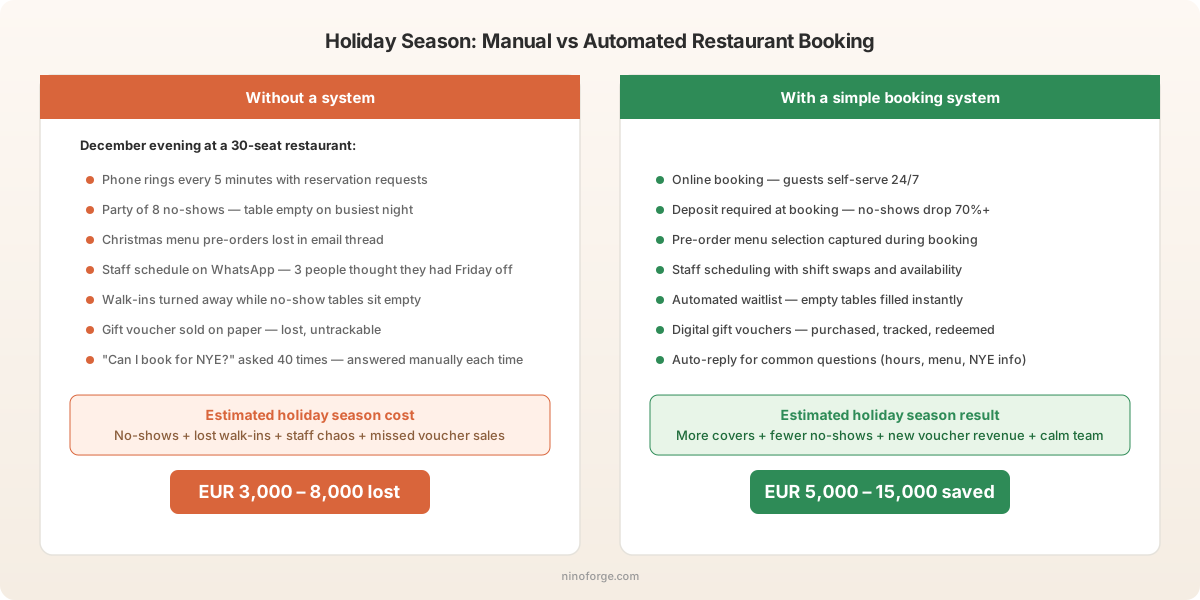
Every December, small restaurants face the same problem. The phone does not stop ringing. Tables are booked weeks in advance. Large parties want special menus. Staff want time off. And then, on the busiest Saturday of the year, a table of eight simply does not show up.
Holiday season should be the most profitable time of the year for a restaurant. Instead, for many small operators, it becomes the most stressful — with revenue left on the table because the systems behind the scenes cannot keep up with the demand.
This is not an article about buying expensive restaurant software. It is about understanding what actually breaks during holiday season and fixing the specific parts that cost the most.
Why Holidays Break Small Restaurant Operations
During a normal week, a 30-seat restaurant might handle 20-30 reservation requests. During the holiday period — from late November through New Year — that number can surge to 80-120 per week.
Most small restaurants manage bookings through some combination of:
- A paper diary at the front desk
- A shared notebook or wall calendar
- WhatsApp messages with regular customers
- Phone calls during service
- Instagram and Facebook DMs
- Email threads for large party requests
This works when volume is manageable. During holidays, it collapses:
- Requests come in faster than they can be processed
- Double-bookings happen because the diary was not updated
- Large party requests with special menu requirements get lost in email threads
- Staff have no visibility into how many covers are expected each night
- Walk-ins are turned away while no-show tables sit empty
The Real Cost of No-Shows During Peak Season
No-shows are a year-round problem for restaurants. During holiday season, the cost multiplies.
A typical no-show rate for small restaurants is around 10-15 percent. During the holiday period, this can climb to 20 percent or higher — partly because diners book multiple restaurants and decide on the night, partly because large party plans change and nobody remembers to cancel.
For a 30-seat restaurant with an average spend of EUR 45 per person:
- One no-show table of 4: EUR 180 lost
- One no-show party of 8: EUR 360 lost
- Two no-shows per night across a 30-day holiday period: potentially EUR 5,000-10,000 in lost revenue
That table could have been filled by someone on the waitlist. But without a system, there is no waitlist — just a missed opportunity.
What a Better Holiday Booking Workflow Looks Like
The goal is not to eliminate the personal touch. Many guests book small restaurants precisely because they like the personal relationship. The goal is to handle the volume without losing the quality.
A practical holiday booking workflow:
Guest finds restaurant
    (Google, Instagram, word of mouth, return visit)
        |
        v
Online booking page
    (available dates, time slots, party size)
        |
        v
Deposit or card hold
    (EUR 10-20 per person for parties of 6+)
        |
        v
Automatic confirmation
    (email + SMS/WhatsApp with booking details)
        |
        v
Pre-order menu selection
    (holiday menu choices captured at booking)
        |
        v
24-hour reminder
    (automated — confirms or catches cancellations early)
        |
        v
Waitlist notification
    (cancelled table → next person on waitlist notified)
Each step reduces manual work and catches problems before they cost money.
Fixing the No-Show Problem
The single highest-impact change a small restaurant can make for holiday season is requiring a deposit or card hold for bookings above a certain party size.
This does not need to be aggressive:
- Parties of 6+: EUR 10-15 per person deposit, deducted from the bill
- Special menus / set menus: Full pre-payment or 50 percent deposit
- NYE / Christmas Eve: Deposit for all bookings regardless of size
Restaurants that implement deposit systems consistently report a 60-80 percent reduction in no-shows. The deposit is not a penalty — it is a commitment signal. Guests who pay a deposit show up.
The key requirement: the deposit must be easy to pay (online card payment at booking time, not a bank transfer) and easy to manage (automatic refund if cancelled within policy window).
Automated Guest Communication
During the holiday period, the same questions arrive dozens of times:
- Do you have availability for December 23rd?
- What is the Christmas menu?
- Can we book for NYE?
- What time is last seating?
- Do you accommodate dietary requirements?
- Is there parking nearby?
An automated message sequence handles the predictable communication:
- Booking confirmation (immediate) — date, time, party size, deposit confirmation, cancellation policy
- Pre-order reminder (7 days before, for set menus) — link to select menu choices
- Booking reminder (24 hours before) — confirm or cancel with one click
- Post-visit message (next day) — thank you, review link, return booking offer
For common questions, a simple FAQ section on the booking page or an auto-reply to messages containing keywords like “menu”, “NYE”, “availability” can reduce the manual workload dramatically.
Staff Scheduling During the Holiday Crunch
Staff scheduling is the second biggest pain point during the holidays. The problems are predictable:
- Everyone requests the same days off (Christmas Eve, Christmas Day, NYE)
- Temporary staff need to be trained and coordinated
- Shift swaps happen informally and create confusion
- Nobody knows the final schedule until the last minute
- Understaffing on busy nights degrades service quality
A basic digital scheduling system — even a simple shared tool — needs to show:
- Who is working each shift
- How many covers are expected (from the booking system)
- Shift swap requests with manager approval
- Availability declarations from staff (who CAN work which days)
- Automatic notification when shifts are assigned or changed
The critical link is between the booking system and the schedule. If Thursday has 45 covers booked and Friday has 28, staffing levels should reflect that. Most small restaurants cannot see this until the day of.
Holiday Staff and Seasonal Hiring
Finding temporary staff for the holiday rush is one of the most frustrating parts of running a small restaurant. Traditional job boards are expensive and slow. Word of mouth is unreliable.
What small restaurants need is a simple way to post seasonal positions and find people who are specifically looking for temporary holiday work — students on break, people wanting extra income, experienced hospitality workers between jobs.
The hiring does not need to be complicated:
- Post what you need (role, dates, hours, pay)
- Reach people who are looking for seasonal work in your area
- Communicate directly
- No recruiter, no long process
If you are a restaurant or small business looking for holiday staff, NinoForge is building a lightweight seasonal jobs platform specifically for this. Simple listings, no subscription, designed for the kind of short-term hiring that small businesses actually need. Get in touch if you want early access.
Gift Vouchers: The Revenue Stream Most Small Restaurants Miss
During November and December, “gift card” and “restaurant voucher” searches spike across Europe and the US. It is one of the easiest revenue opportunities for a small restaurant — and one of the most commonly missed.
Most small restaurants that sell gift vouchers do it with:
- Paper vouchers from a pad behind the counter
- Handwritten cards with an amount and a serial number
- No tracking of issued, redeemed, or expired vouchers
- No online purchase option
The problems:
- Customers can only buy in person (during the busiest period, when staff have no time)
- Paper vouchers get lost
- No way to know how many are outstanding
- No expiry management
- No re-purchase or top-up
A simple digital voucher system solves all of this:
- Customer purchases online (pay by card, receive voucher by email)
- Unique code per voucher (trackable, redeemable at POS)
- Automatic expiry (12 months typical in Europe, varies by jurisdiction)
- Dashboard showing sold, redeemed, outstanding, expired
- Available 24/7 — not limited to restaurant opening hours
For a small restaurant, holiday gift voucher sales can add EUR 2,000-10,000 in revenue during November-December alone — with near-zero operational cost.
A Simple Technology Stack for a Small Restaurant
You do not need a full restaurant management platform. You need a small number of things that work together:
Booking page
    (online, mobile-friendly, linked from Google/Instagram)
    |
    +-- Availability calendar
    +-- Deposit payment (Stripe / Mollie)
    +-- Pre-order menu selection
    |
    v
Guest communication
    |
    +-- Booking confirmation (email / WhatsApp)
    +-- Reminders (24h before)
    +-- Post-visit (review request)
    |
    v
Operations
    |
    +-- Staff schedule (shift view, availability)
    +-- Cover forecast (from bookings)
    +-- Gift voucher management
    |
    v
Dashboard
    |
    +-- Bookings overview
    +-- Revenue forecast
    +-- No-show tracking
    +-- Voucher sales
This does not need to be one monolithic system. It can be built as focused tools that fit around how the restaurant already operates.
Phased Implementation
You do not need to fix everything before the holidays. Start with the problem that costs the most.
Phase 1 — Stop the no-shows (implement now)
- Online booking with deposit for large parties
- Automated confirmation email/WhatsApp
- 24-hour reminder with confirm/cancel link
Expected impact: 60-80% reduction in no-shows. Immediate revenue recovery.
Phase 2 — Capture holiday revenue
- Digital gift voucher system (online purchase, email delivery)
- Pre-order menu selection during booking
- Waitlist management (fill cancelled tables automatically)
Expected impact: New voucher revenue stream. Better kitchen preparation for set menus. Fewer empty tables.
Phase 3 — Fix the operational chaos
- Staff scheduling tool (shifts, availability, cover-based staffing)
- Automated FAQ responses for common holiday questions
- Post-visit review requests
Expected impact: Calmer team. Better service on busy nights. More reviews for next season.
Frequently Asked Questions
Will customers actually pay a deposit to book a restaurant?
Yes — particularly for holiday bookings where they are committing to a specific date. The key is making the amount reasonable (EUR 10-15 per person, not the full bill) and clearly deducting it from the final bill. Many diners already expect this for larger parties and special occasions.
I only have 20 seats. Is this overkill?
No. Smaller restaurants are actually hit harder by no-shows because each empty table represents a larger percentage of capacity. A single no-show party of 6 in a 20-seat restaurant means 30 percent of your covers are gone. The simpler your operation, the simpler the system can be.
What about regular customers who always just call?
Keep letting them call. The online booking system handles the surge — the 80 percent of holiday requests that come from occasional diners, office parties, and new customers. Your regulars keep booking however they prefer. The system catches everything else.
Do I need to replace my existing booking system?
Not necessarily. If you already use a booking platform and it works, the question is whether it handles deposits, pre-orders, waitlists, and automated communication well enough for holiday volume. If it does not, a custom layer on top may be more practical than switching platforms.
How long does it take to set this up?
Phase 1 (online booking with deposits and confirmations) can be operational within 2-4 weeks if built around your specific needs. Off-the-shelf solutions can be faster but may not fit your workflow. The important thing is to start before the holiday rush — not during it.
Ready to Handle This Holiday Season Better?
If your restaurant is already feeling the pressure of holiday bookings — or you are trying to avoid the chaos of last year — NinoForge can help you build a focused system around how your restaurant actually works.
We do not sell generic restaurant software. We build the specific tools you need: a booking flow that takes deposits, automated communication that saves your team hours, staff scheduling that matches covers to shifts, or a digital voucher system that sells while you sleep.
Start with one problem. Build a small working solution. Expand as needed.
Tell us about your restaurant or book a free discovery call to discuss what would make the biggest difference for your holiday season.